
Does THCA Turn Into THC When Smoked – Decarboxylation Explained
The quick bite
Yes, smoking converts part of THCA into THC through decarboxylation. The conversion is never complete: one study recovered only about 30% as THC in smoke. Raw THCA is not intoxicating, but heated THCA is.
Most explanations of THCA stop at the line that heat turns it into THC. That is accurate, but it skips the details that explain why a flower labeled 25% THCA doesn't hit like 25% THC, and why the same plant material can be non-intoxicating in one form and intoxicating in another.
The process behind all of it is called decarboxylation.
This guide covers what happens at the molecular level, how hot it needs to get, how much THC actually comes out the other side, and how THCA and THC differ once the reaction is done. If the compound itself is new to you, the beginner's guide to THCA is a good place to start.
Does THCA Turn Into THC When Smoked?
Smoking THCA flower converts a portion of its THCA into THC, because the flame's heat strips off a carboxyl group, but the conversion is never complete.
In a 2005 forensic study, researchers spiked cigarettes with a known amount of THCA-A (the main form of THCA) and measured what came out in the smoke. Only about 30% was recovered as THC, and even under optimized laboratory conditions the maximum conversion was about 70%. [1]
That doesn't make smoked THCA weak. A 2016 review found that THCA can represent up to 90% of the total THC in a cannabis plant, so even a partial conversion of that large pool produces an intoxicating amount of THC. [2]
What Is Decarboxylation?
Decarboxylation is a chemical reaction in which a molecule loses a carboxyl group (COOH) as carbon dioxide, which is how THCA becomes THC.
Cannabis plants don't make THC directly. They make THCA, short for tetrahydrocannabinolic acid, in the glandular trichomes of their flowers and leaves, and THC only appears afterward. [2] Chemists call THCA the acidic form and THC the neutral form, and the key structural difference between them is that carboxyl group. [3]
Heat gives the molecule enough energy to shed that group as carbon dioxide, leaving THC behind. Light and time can do the same job more slowly, and the same reaction converts CBDA into CBD and CBGA into CBG. [3]
That is why unheated and heated flower behave so differently. The name on the label stays the same, but the molecule your body meets is not.

What Temperature Does THCA Turn Into THC?
THCA begins converting to THC at about 90°C (194°F), and the reaction speeds up sharply as the temperature rises.
A 2016 literature review by nova-Institut researchers pooled earlier heating experiments and found that full conversion takes hours at modest temperatures and only seconds at high ones. [4] The table shows the review's reference points, plus the peak-THC finding from a separate heating experiment.
|
Temperature |
Time to full conversion |
Notes |
|
100°C (212°F) |
About 3 hours |
Long, gentle heating |
|
145°C (293°F) |
About 5 to 10 minutes to peak THC |
THC content falls with longer heating |
|
Above 160°C (320°F) |
About 10 minutes |
THC begins evaporating from about 157°C (315°F) |
|
200°C (392°F) |
Seconds |
Fastest conversion, with THC already evaporating |
The 100°C, 160°C and 200°C figures and the evaporation point come from the review. The 145°C peak is from a heating experiment described in a 2016 University of Mississippi study. [5]
That Mississippi team heated cannabis extracts at 80, 95, 110, 130 and 145°C for up to 60 minutes. THCA followed a first-order reaction, meaning the amount converting at any moment is proportional to the amount still waiting to convert, and its rate was about twice that of CBDA and CBGA.
A lit flower's burning tip is far hotter than anything in these tests, so conversion in the glowing zone takes seconds. The same heat also evaporates and breaks down some of the THC that forms, which fits the roughly 30% recovery in the smoking study. [1]
How Much THCA Becomes THC After Heating?
Decarboxylation of THCA never turns all of a flower's THCA into THC, because the molecule loses weight in the reaction and some THC is lost to evaporation and breakdown.
Two separate effects shrink the final number. One is fixed chemistry, and the other is what gets lost along the way.
Why 1g of THCA Never Makes 1g of THC
THCA sheds its carboxyl group as carbon dioxide, so one gram of THCA can produce at most 0.877 grams of THC. Labs build that correction factor into potency math: total THC equals THC plus THCA multiplied by 0.877. [3]
A flower testing at 25% THCA tops out at about 21.9% THC (25 × 0.877 = 21.925) before any other losses.
Where the Lost THC Goes
Beyond the weight difference, some THC is lost in practice. When the University of Mississippi team heated cannabis extracts at 110°C in a vacuum oven, the combined THCA and THC amount (by molar count) ended about 8% lower than where it started. [5]
Three factors show up in the research:
-
Evaporation. THC begins to evaporate from about 157°C (315°F), so very hot conditions can lose THC while still making it. [4]
-
Oxidation. In a 2005 oven test at 160°C and 180°C, some THC oxidized into CBN (cannabinol), a different cannabinoid, as summarized in the Mississippi study. [5]
-
Combustion. In the smoking simulation, only about 30% of the spiked THCA was recovered as THC. [1]
The THC figure on a lab report is a ceiling. What reaches your lungs or a baked batch depends on how hot the material gets, how long it stays there, and how evenly it is heated.
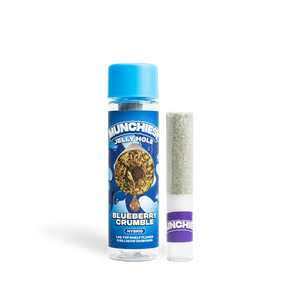
💎 Not your average preroll. Jelly Holes. 2g THCA with a diamond core and a glass tip for the slow, flavorful burn.
Does THCA Convert to THC on Its Own Over Time?
Yes, THCA slowly converts to THC during drying, curing, and storage, with no flame or oven involved. THCA decarboxylates gradually during storage and fermentation, with the THC that forms degrading further into CBN under the influence of temperature, oxidation, and light.
Purified THCA shows how readily this happens. The THCA-A reagent used in a 2017 receptor study already contained 2% THC. [6] The same paper notes that THCA appears more stable inside intact flower, where it sits in glandular trichomes alongside terpenes that act as protective antioxidants.
This is why a lab report is a snapshot. The THCA-to-THC ratio on a certificate reflects the sample on the day it was tested, and it can drift as the flower ages.
THCA vs THC: How Do the Effects Differ?
THCA does not produce a high, while THC does, because THC binds strongly to CB1 receptors and THCA binds to them very weakly. [6]
|
Feature |
THCA |
THC |
|
Chemical form |
Acidic, carries a carboxyl group |
Neutral, carboxyl group removed |
|
Where it comes from |
Made by the cannabis plant |
Forms from THCA through decarboxylation |
|
CB1 receptor binding |
Weak, with a Ki of about 3.1 µM |
About 62 times stronger |
|
Intoxicating in humans |
No |
Yes |
The binding figures come from a 2017 assay in human cells. [6] Once THCA has decarboxylated, the THC that forms is the same molecule found in any other THC product, so the experience depends on how much converted and on the person, not on the fact that it started as THCA. For a full side-by-side with the version of THC sold in gummies, see THCA vs Delta 9.
Why THCA Does Not Get You High
In the 2017 binding assay, THC showed 62 times greater affinity at CB1 and 125 times greater affinity at CB2 than THCA-A, and the authors concluded that THCA-A has little affinity or efficacy at either receptor. [6]
Earlier studies disagreed, with some reporting stronger binding. The 2017 authors argued those results were best explained by THC contaminating the THCA samples, which fits the 2% THC found in their own reagent. [6] A separate 2016 review states that THCA does not cause psychoactive effects in humans and does not convert to THC inside the body, so heat has to come first. [2]
What Researchers Have Studied in THCA So Far
THCA draws research attention because it doesn't intoxicate, but the findings so far come from cells and animals, not from people using flower.
In a 2017 study, THCA activated a receptor called PPARγ and protected against nerve damage in mice given a mitochondrial toxin (3-NPA), improving movement problems and preventing degeneration in the striatum, a brain region involved in movement. [7] A 2020 mouse study reported that THCA reduced collagen-induced arthritis, acting partly through CB1 receptors and partly through PPARγ, which shows the question of THCA's receptor activity is not fully settled. [8]
Both studies used purified THCA in cells and mice. The results can't be applied to smoked flower, where heat changes the compound, or to any consumer product.

How to Read THCA vs Total THC on a Lab Report
A lab report's total THC equals delta-9 THC plus THCA multiplied by 0.877, which estimates the THC available after full decarboxylation.
Take a flower report that lists 0.5% THC and 24% THCA. The total THC is 0.5 + (24 × 0.877), which comes to about 21.5%. Simply adding the two would give 24.5% and overstate it, because THCA loses weight as it converts.
Two assumptions sit inside that number: every bit of THCA converts, and none of the THC is lost afterward. The smoking study shows neither holds when flower is burned, so total THC is a theoretical maximum rather than a forecast of what you'll inhale. [1]
When you read a report, check these four things:
-
THCA and THC on Separate Lines: Liquid chromatography (HPLC) uses no heat, so it reports the acidic and neutral forms separately. [3]
-
The Testing Method: Gas chromatography heats the sample, which decarboxylates THCA before it is measured, so a GC report shows converted totals instead of THCA. [3]
-
The Weight Basis: USDA requires official THC percentages to be reported on a dry weight basis, which makes results higher than the same sample reported at fresh weight. [3]
-
A Total THC Line: This is the number that accounts for THCA, so it is the one to compare across products.
Federal hemp testing follows the same logic. USDA's rule requires post-decarboxylation methods or an equally reliable alternative, with results that reflect the total THC from the sum of THC and THCA.
Key takeaways
- Decarboxylation is the heat-driven loss of a carboxyl group that turns THCA into THC, and it starts at about 90°C (194°F).
- Conversion is partial in smoke: one forensic study recovered about 30% of THCA as THC when smoked.
- One gram of THCA can produce at most 0.877 grams of THC, so a flower testing at 25% THCA tops out near 21.9% THC.
- THC binds CB1 receptors about 62 times more strongly than THCA, which is why raw THCA does not produce a high.
- Total THC on a lab report is THC plus THCA multiplied by 0.877, a theoretical maximum rather than what smoke delivers.
The Group Chat
Find your next favorite.
Lab-tested, third-party verified and shipped to your door.
Shop THCA PRODUCTSSources
Every stat in this post is checked against these.- Dussy FE, Hamberg C, Luginbühl M, Schwerzmann T, Briellmann TA. Isolation of Δ9-THCA-A from hemp and analytical aspects concerning the determination of Δ9-THC in cannabis products. Forensic Science International. 2005.pubmed.ncbi.nlm.nih.gov
- Moreno-Sanz G. Can You Pass the Acid Test? Critical Review and Novel Therapeutic Perspectives of Δ9-Tetrahydrocannabinolic Acid A. Cannabis and Cannabinoid Research. 2016.pmc.ncbi.nlm.nih.gov
- Jackson DL, Lessl J, Coolong T, Joy N. An Introduction to Hemp Chemistry and Lab Results. University of Georgia Cooperative Extension, Circular 1209. 2026.fieldreport.caes.uga.edu
- Iffland K, Carus M, Grotenhermen F. Decarboxylation of Tetrahydrocannabinolic acid (THCA) to active THC. nova-Institut for the European Industrial Hemp Association. 2016.hemp.ucdavis.edu
- Wang M, Wang YH, Avula B, et al. Decarboxylation Study of Acidic Cannabinoids: A Novel Approach Using Ultra-High-Performance Supercritical Fluid Chromatography/Photodiode Array-Mass Spectrometry. Cannabis and Cannabinoid Research. 2016.pmc.ncbi.nlm.nih.gov
- McPartland JM, MacDonald C, Young M, Grant PS, Furkert DP, Glass M. Affinity and Efficacy Studies of Tetrahydrocannabinolic Acid A at Cannabinoid Receptor Types One and Two. Cannabis and Cannabinoid Research. 2017.pmc.ncbi.nlm.nih.gov
- Nadal X, del Rio C, Casano S, et al. Tetrahydrocannabinolic acid is a potent PPARγ agonist with neuroprotective activity. British Journal of Pharmacology. 2017.doi.org
- Palomares B, Garrido-Rodriguez M, Gonzalo-Consuegra C, et al. Δ9-Tetrahydrocannabinolic acid alleviates collagen-induced arthritis: Role of PPARγ and CB1 receptors. British Journal of Pharmacology. 2020.pmc.ncbi.nlm.nih.gov
- U.S. Department of Agriculture. 7 CFR 990.25, Standards of performance for detecting total delta-9 tetrahydrocannabinol (THC) concentration levels. Code of Federal Regulations, Domestic Hemp Production Program. 2019.law.cornell.edu
Last reviewed November 12, 2026 by Omer. First published November 11, 2026.